Are You Subject to The Estate Planning Minefield? Beneficiary Designations Should Not Be Overlooked

You probably had no idea about just how many things can go wrong by listing the wrong person or a person who should no longer have this authority on your beneficiary designation forms.

There are some best practices that you can implement in your estate planning instead that could minimize the possibility for unfortunate and uncomfortable situations for your loved ones.

Most people are familiar with the beneficiary designation form, given that they would have come into contact with it when opening a 401(k), an IRA, or completing a life insurance policy application. This form designates who is eligible to receive that asset if the account owner passes away.

Unfortunately, however, many people don’t understand the far-reaching consequences of a piece of paper such as a beneficiary designation form since it overrides other instructions in your estate plan including your will.

These forms can create turmoil, unintended bequests to former spouses and even confusion. Multiple account types are governed by beneficiary designations, such as a annuities, IRAs, life insurance, and 401(k)s. These contractual provisions override your will, meaning that if you have an outdated beneficiary designation form, the person listed on that form is still legally entitled to receive your assets even if you are no longer married to them.

It can be very problematic to fail to update your beneficiary designation forms. Set an annual reminder on your calendar to sit down with your estate planning attorney and discuss beneficiary designation forms and other tools.      

How Many People Don’t Have A Will In 2020?

Every year Caring.com conducts a study to determine where people’s minds are at with regard to estate planning. There are many different questions asked inside this survey that it typically involves more than 2,400 people.

But one of the most important is to determine who already has an estate plan in place. For middle-aged Americans with a will, the study found that there has been a near 25% decrease for people who have this most important and vital estate planning documents.

In 2017, older and middle-aged Americans who participated in the survey reported that over 40% of middle-aged and older Americans reported that they had a will. But only 32% had that same document as shared in the 2020 survey. This is a significant decrease in the number of people who have critical estate planning documents, like a health directive, a living trust, or a will.

The lack of these important documents can be alarming for any family, since estate planning helps to establish multiple goals. A will is also your opportunity to name a person who will be responsible for caring for your minor children or making decisions about your health if you become incapacitated or are unable to do so. The study also found that for Americans earning more than $75,000, only 45% of them in that category had a will in place.

This is also problematic news given that a sudden incapacitation or death could have big consequences for your family and loved ones.        

Don’t Keep Financial Secrets from Your New Mid-Life Partner

There are many complicated facets of estate planning that arise when marrying someone in mid-life. Keeping financial secrets and refusing to share your financial history with your partner could set you both up for problems in the future.

Furthermore, a mid-life marriage, including a second or third marriage, requires upfront honesty about both of your individual financial situations and how your marriage can impact your estate planning.

One 2020 creditcards.com survey of over 2500 adults in relationships found that nearly half of respondents were hiding a savings, checking or credit card account from their partner. Up to 57% of millennials, 37% of baby boomers, and 45% of GenX-ers had deceived their partners financially. This form of financial infidelity could be very problematic should the other person find out about it and could add to an increasing layer of complexity.

When joining your finances with a mid-life partner, consider a discussion with a CPA and other financial professionals. 

If you already have retirement accounts and estate planning details set up for you personally, this information should be discussed with your new spouse. It’s a different strategy to go from creating all of this information on your own to reflect your individual needs to moving it over to combined finances and estate planning.

Updating all of your key documents, including your beneficiary designation forms, should come at the top of your priority list.

If you’re stuck on how to get started and need more advice, set up a time to speak with a trusted estate planning lawyer who can guide you through which parts of your estate plan need to be updated and how to consider some of the complexities of combining interests and finances in a later-in-life marriage.      

Understanding the Complications of Annuities in An Estate Plan

Do you have an annuity? Is this a financial tool you created for your own future but is something that was ultimately moved out of your possession/estate and into the management of a trust? Read on to learn more about key issues that emerge with trusts owned by annuities.

If you have placed an annuity inside a trust, this can get very confusing regarding the beneficiary designation. You should have a working knowledge of the type of annuity you have selected and how these individual annuities function. Recognize at first that not all annuities are the same.

One of the most important distinction of different types of products is whether or not the annuity has been funded with after tax or pre-taxed dollars. This is basically asking whether or not this is an investment account or a retirement account. An annuity could be part of your IRA investments and any annuity that has been funded with pre-taxed retirement dollars is referred to as a qualified annuity.

With a qualified annuity, ownership should most likely not be transferred to the trust itself. If an annuity is non-qualified; meaning that it has been funded with after tax dollars, there is a strong probability that the annuity should be funded into a trust enabling a successor trustee to exercise control over the annuity in addition to other trust assets. To ensure this is the right course of action for you, schedule a consultation with an estate planning lawyer.       

Why Is Retirement Planning Complicated with A Late Divorce?

Getting divorced late in your marriage, such as several decades in, can create significant complications for a retirement planning. One partner might have saved a lot more than the other with the intention that the savings will be combined later, or the partners might have merged their retirement funds making it difficult to disentangle them upon a divorce.

A divorce can be financially devastating for a person at any age, but this influence is much higher when the partners are approaching retirement because the cost of living alone is considerably higher than when two people are sharing expenses. A 2017 report, completed by the PEW Research Center, shows that divorce rates for those couples over age 50 have nearly doubled since the 1990s; a phenomenon known as grey divorce.

Late divorce gives both parties involved less time to pay off debts, handle the ups and downs in the stock market or recoup any losses. If one or both parties are already retired, there may not be an existing steady source of income to rely on for their complicating matters.

What Should You Do Right After A Loved One Passes Away?

The loss of a loved one can be an emotional and overwhelming experience and it can feel very difficult to understand what you need to do to protect your interests and next steps that you need to take.

Get help from a NJ estate planning lawyer today.

However, there are many important things to contemplate during this difficult time related to your loved one’s finances. Don’t make any decisions too quickly, since some of the choices you make early on could be difficult or even impossible to reverse. After determining your loved one’s final wishes for a funeral and listing an obituary, it is important to find the necessary paperwork to help you with the next steps to managing your loved one’s estate.

Other important paperwork could include titles to cars or deeds to property. You will need to have certified copies of the death certificate in order to accomplish this. Your loved one’s finances should be the next area to tackle.

This includes making a full list of all the debts and assets. Retirement plans, 401(k)s and IRAs are an example of assets. Determine who was listed as a beneficiary on any retirement plans since these assets will passed to the person named and the same follows for life insurance policies. If there was a mortgage on a piece of real estate, it is important to continue making the monthly payment and the same holds for any insurance payments. If there was an automobile or home involved, the insurance coverage should also be continued.

Do you want to include instructions for your loved ones to help with your estate? Speak with an estate planning lawyer today to get started. 

My Roller Coaster Face, Fear/Excitement, Dinner Event

The picture below was taken at Six Flags Great Adventure on a ride called Kingda Ka. To protect the innocent, I blurred out the faces of my friend as well as the kids who rode with us. I didn’t think it would be right for me to cover my face. 

Funny thing, I still remember exactly how I felt at that very moment on the ride. Anybody who’s been on that ride knows it’s a little ridiculous – it goes from 0 to 128 miles per hour in a few seconds. 

Then why the heck am I smiling? Clearly, it’s not a comfortable smile. I’m smiling because somewhere deep down inside of me I have confidence that this roller coaster isn’t coming off the tracks. If I didn’t have that confidence, I wouldn’t be excited – I would be fearful. (Okay, honestly speaking – there’s some fear there as well too.) 

As I type this message, the stock market has had two consecutive down days and drops of almost 2000 points. Even the most confident investors are probably a little fearful. But long-term investors cannot and should not try to predict if this is the start of a longer trend or an isolated time period. The only other 1,000-point drops for the Dow Jones Industrial Average (DJIA) were on February 5th and 8th of 2018. Since then, the DJIA went on to make many new highs. (In case you missed it, I recorded a video about this a few weeks ago: click here 

About a hundred years of history tells me, with confidence, that: 

A. Roller coasters don’t go off the tracks, and 

B. Long-term investors come out ahead in the long run. 

When you integrate your legal plan, tax plan, and financial plan you will come out ahead. I’m continuing to watch the markets, but I’m sending this message to remind you that this is not the time to react emotionally. 

If you are currently a client and are interested in learning how developments in 2020 on the tax, financial and legal fronts will impact you – we are hosting a dinner event on March 4, 2020. I’m not sharing the details in this email because it’s only open to our clients and their guests. We are keeping the room small and intimate, but if you’re interested in attending please reply and we will get you on the list.  

Three Estate Planning Steps to Take for New Parents

It’s very exciting to think about all of the possibilities ahead of you and your family when you have your first child, but in addition to all of the other busy new parent related tasks on your list, making an estate plan should jump to the top of the priorities.

Putting off this process before your first one is common because many spouses simply decide to pass all their assets onto one another. However, three estate planning steps should be taken into consideration when having your first child and updating your estate plans to reflect the new structure of your family.

These include making a will, buying life insurance, and naming a guardian. Each of these steps works best when you’ve implemented the other two.

In the creation of your will, you are able to name a guardian who can take over care for your minor child in the event that you and your spouse become unable to do so.

Creating a will can be done by sitting down with an experienced estate planning attorney. In addition, you should also consider buying a life insurance policy that will help provide immediate benefits for your loved ones should something ever happen to you.

Are There Any Dangers with DIY Estate Planning?

Today, thanks to the multitude of online resources and tools you can find about many different legal processes including estate planning, it’s easy to feel a sense of security about taking on this project DIY. Creating your own will might seem simple enough, but it’s a task you can tackle on your own. However, minor changes in wording can have big ramifications on how your will is processed through probate and who receives what.

In these situations, it can sometimes make much more sense to partner with an experienced and dedicated estate planning attorney who can guide you through the process. Avoiding DIY estate planning and turning right to an attorney is also recommended if you intend to use a trust.

Trust can be tricky because at their base element, they are a legal document to pass assets to a beneficiary. However, trust can involve much more complicated maneuvers such as conditions attached to a bequest like handing out money only after the beneficiary reaches a certain age or dispersing funds over time. There are tax advantages to irrevocable trusts, but the ability to update a revocable trust also means this is something you should consider while consulting with your estate planning attorney.

While there are usually some estate documents that could be done without consulting with a CPA or a lawyer, the potential future impacts of these documents cannot be understated. Partnering with an experienced and dedicated estate planning lawyer will not only give you peace of mind, but ensure that you have protected what is most important to you. Avoiding these mistakes can make things that much easier for your loved ones.

Get a Spring Cleaning Start on Estate Planning

It’s the perfect time of year to incorporate your estate planning into the bigger picture. Estate planning requires a team approach and communication with all relevant parties. If you’re also a business owner, you can’t complete the process of estate planning without incorporating business succession planning and asset protection planning.

 All of the key stakeholders and outside professionals who are connected to all of these decisions should be involved as to understand the process. If your estate planning papers are all old or if you’re not even sure where to find them, set aside time to schedule an in-person meeting with your lawyer. Starting all over with a new set of documents for whatever you need in this stage of life is recommended.

Estate planning involves critical decisions about financial, family tax, business, and legal decisions. It also helps to reduce the state taxes, secure your own financial future, determine what your retirement will look like, and influences your overall assets.

The first step in accomplishing the estate planning process is to reach out for expert advice. If you already have a tax accountant you trust, they will likely know an attorney or a financial planner who can help you.

Tax time is also the perfect time to reevaluate your overall financial picture and to make decisions about how your estate planning and other future plans should be adjusted in the future.

My Parent is Struggling with Dementia: What Now?

If your loved one was recently diagnosed with dementia, the entire family has plenty of things to think about. It’s hard to determine when things have gotten so bad that you need additional support or to consider whether they need to move to a new place so you can either keep an eye on them or have a group of people, like facility staff, do the same. 

Young carer walking with the elderly woman in the park

When a loved one is diagnosed with dementia, the disease might have already progressed. However, others might catch these situations early on in the process and recognize that their loved one, by all accounts, still appears to be fine. 

Dementia can cause what seems like sudden changes to an outsider, or it can be more of a gradual decline. If multiple family members are involved in making these care decisions, this can also complicate the situation if not everyone agrees.

If you feel like things have become a safety risk but your brother argues that your mom or dad is fine, you might push off the decision over creating a power of attorney or making a care plan. There’s no one tried and true way to decide when the disease has progressed far enough that it’s worrisome; you’ll have to make that call for yourself.

Having a power of attorney document in place sooner rather than later means that when the time comes, if your loved one is no longer able to make decisions for themself or take care of themselves that you or another power of attorney agent can then step in. While you might hope that you have plenty of time before that becomes necessary, if your loved one is struggling to pay their bills, has difficulty remembering where they are, or has had any near-miss or near-injury events in the recent past, now is a time to take more serious action.

Need help with a dementia-related power of attorney? Contact our office today for help from a Mississippi lawyer. 

Attorney Shah Chimes in: Wall Street Journal Estate Planning

Attorney Neel Shah was recently featured in a Wall Street Journal article about making decisions to distributing unequally among your children.

While the easiest solution to estate planning would be to divide up your property equally among your heirs, this doesn’t always fit with family dynamics.

Whether you’re paying for things now and trying to keep things equal while your children are young or making key decisions about what happens to your property when you pass away, you have to make personal decisions based on your family’s needs and the kinds of assets you hold.

When carrying over this process for estate planning purposes, consider the following questions in deciding the right structure for passing on your assets and collections to your kids:

  • Does one child have more of an interest in carrying on a family business?
  • Do one or more children feel like they have a personal or sentimental connection to certain items you own?
  • Do any of your children struggle with managing money effectively?
  • Do any of your children cope with problems like addiction that could impair their ability to manage finances properly?
  • Does one child not have the same economic opportunities with their education and training or have specific concerns like supporting a special needs child?

Given that each family has their own unique issues at play, a one-size-fits-all estate plan rarely, if ever, makes sense. While you might not know which strategies you want to use right away, a consultation with a dedicated estate planning lawyer can help you navigate this process more easily and ensure that you create a plan most in line with your family’s wishes and needs.

Getting Married Midlife: Don’t Forget Your Estate

Getting married to someone in later years is becoming increasingly common. In fact, plenty of research studies are looking into how Millennials choices to get married later could have ripple effects across society and the economy. But there are other reasons you might get married later in life, too.

Pretty smiling older woman with a green frog in her hands. Concept for love in middle age, partnership or valentine.

But what about your own finances? Have you thought about how you’ll plan effectively for your estate when it’s been single living up until now? Most couples entering a marriage later in life have long managed their finances on their own and will have important decisions to make about how best to set up their new life together.

And one aspect of your newly joined partnership should include your estate planning documents. The choices you previously made about your beneficiaries, your power of attorney agent, and many more might have made sense when you were a single person. Perhaps you most recently updated them after a first marriage that ended in divorce.

But adding a new partner into your world calls you to be more effective in terms of planning with this new person on board. Will they be updating their documents to reflect your role in their life, too? How will you handle retirement accounts that both of you have likely accumulated over many years on your own? How do children from past marriages and relationships, if any, factor into these equations? These and many more important questions must be answered.

If you need a place to get started, a consultation with your estate planning lawyer is one of the most effective ways to ensure that you’ve covered all your bases in your planning. Sit down today with an estate planning attorney to discuss what needs to change and what should stay the same if you need to update your estate with your new spouse in mind.

Why You Need A Plan for Your Estate No Matter Your Stage in Life

There are so many misconceptions surrounding the process and the need for estate planning. It’s all too easy to brush this off or assume that you don’t make enough money, aren’t old enough or don’t have enough unique considerations to put you at the top of your list for an estate planning priority. But these misunderstandings and misperceptions can have far-reaching implications for your loved ones, regardless of your current stage of life.

During College

During and right after college, it’s important to have necessary health care and medical power of attorney documents, including updated beneficiaries on all accounts, durable power of attorney for finances, and durable power of attorney for health care.

Getting Married

When getting married, it is important to expand your estate planning toolkit to include wills, like advance directives and updated beneficiaries on all accounts.

Starting A Family

Updating your will to ensure that you have appointed a guardian to step in and take care of your minor child if you are unable to do so is important. Other issues to consider include legacy building and the connection to your overall finances.

Scheduling a consultation with a knowledgeable estate planning lawyer today can help you to understand the many different ways that your life can be affected by estate planning. You can protect yourself and your loved ones.       

Update Your Estate Plan to Match SECURE

A few impacts emerge from the Secure Act or the Setting Every Community Up for Retirement Enhancement; one of the biggest challenges associated with carrying on your estate plan following the implementation of the secure act is that this law eliminated a very popularly used estate tax strategy that previously applied to IRAs.

If a person who is not of age to take required minimum distributions from the IRA, inherit such an account, they could stretch withdrawals from their account over their lifetime, which was a popular strategy.

However, the elimination of this technique could force tax-deferred assets to be withdrawn sooner than anticipated, which could have big impacts on estate planning for those who had a lot of assets inside their retirement plan. This is just one reason why it is important to consider secure retirement and estate planning guided by the support of a knowledgeable attorney.

An attorney can have a big impact on the outcome of your estate planning, and it can also help to clarify what you need to know.

Now is the perfect time to review your beneficiary designation forms from any retirement accounts; you might need to update both your strategy as well as your decisions about who should receive those assets when something happens to you. 

Need help with your NJ estate planning? Our office is here to help you create a customized plan with your needs in mind. 

What You Should Know About New Jersey’s Inheritance Laws

There is no longer an estate tax in New Jersey, but there is still an inheritance tax. This law has many different exemptions and complications, making it all the more important to retain an experienced New Jersey estate planning lawyer.

Until January 1st, 2018, New Jersey had both an estate tax and an inheritance tax. After that estate tax was repealed on January 1st, however, there is only an inheritance tax in addition to any applicable federal estate tax. If you are a family member of the deceased person, however, you could be exempted from the inheritance tax.

This is true if you are the mutually acknowledged child or stepchild, a great-grandchild, spouse, domestic partner, civil union partner or parent or grandparent of the deceased. Furthermore, inheritances that are left behind to schools, religious institutes, and charitable organizations are exempted from the inheritance tax.

There are many different federal and estate tax situations that you should incorporate into your overall estate planning. Beyond the state estate tax, you should also consider the federal estate tax returns, the federal estate and trust tax income return, income tax return, and the final state and federal income tax returns.

Make sure that you have had an experienced and knowledgeable New Jersey estate planning lawyer to review the basic requirements to ensure that your will is viewed as legitimate in New Jersey. There are a couple of different requirements that must be met in this effort. Schedule a consultation today with an experienced estate planning lawyer to learn more about how this can affect you.

What Happens When You Fail at Market Timing?

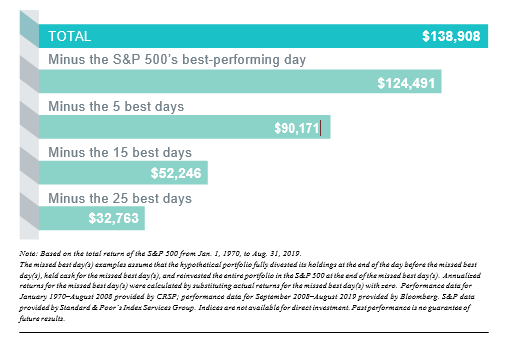
The impact of missing just a few of the market’s best days can be profound, as this look at a hypothetical investment in the stocks that make up the S&P 500 Index shows.

A hypothetical $1,000 turns into $138,908 from 1970 through the end of August 2019. Miss the S&P 500’s five best days and that’s $90,171. Miss the 25 best days and the return dwindles to $32,763. There’s no proven way to time the market—targeting the best days or moving to the sidelines to avoid the worst—so history argues for staying put through good times and bad. Investing for the long term helps to ensure that you’re in the position to capture what the market has to offer.

Hypothetical growth of $1,000 invested in US stocks in 1970

Sources: Dimensional Fund Advisors LP is an investment advisor registered with the Securities and Exchange Commission.

How to Fit Your Stepkids Into Your Estate Plan

One of the most complicated facets of estate planning emerges when you’ve been married more than once or have children from a previous relationship. Naturally, whether or not you want to leave something behind for all your children and stepchildren is a personal decision and you can decide what’s best for you.

But if you do determine that you’d like to leave something for your stepchildren, it’s wise to discuss that situation with your estate planning attorney. Unfortunately, what tends to happen with most people who don’t consult an expert in which one set of children ends up taking everything and it all depends on how the estate plan was structured before the person passed away.

Make sure that you share with your attorney that some of those who are to receive your property when you pass away are stepchildren rather than blood relatives. Be as specific as possible in your plans about what you intend for them to have- these details make it easier to have your estate carried out as you wish in the future.

Don’t list that you want a piece of property or an amount of money to be split among “your children.” List out their names directly so that it’s very clear you did intend to include- or exclude- certain people in your will

It can also be helpful to establish a trust for estate planning purposes if you have complex concerns like how to pass on assets to stepchildren. 

If you want everyone to share things, you need to delve into the details and make sure that your lawyer has reviewed your proposed will or drafted it directly. Don’t let your loved ones end up embroiled in an estate planning dispute in the courts that could decimate your assets or leave someone out in the cold if that’s not what you intended.

Does an Executor of an Estate Have to Use an Attorney to Execute the Will?

When you are appointed as the executor of an estate, it is important to review the instructions from the person who created this document.

When you create your own estate, you leave behind instructions for how your property should be distributed when you pass away, but you also nominate a person to administer your estate. This executor plays an important role in gathering all of your estate property, making distributions to will beneficiaries and paying estate debts.

In order for a will to be classified as legally valid and effective, it needs to be submitted to a court for probate. Whether or not an executor should use an attorney to shepherd the will through the process of probate might differ from one state to another.

For example, in New Jersey, it can make sense to retain a probate lawyer right away if the estate is complex. However, there are other states where it is the executor’s discretion about whether or not he or she intends to hire someone to assist with the administration of the estate. It is a good idea to retain an experienced and knowledgeable attorney when going through this process.

An attorney can play an important role in explaining the process to the person appointed as executor and can help to answer any questions that emerge in this early phase of estate planning. Scheduling a consultation with a trusted estate planning lawyer can be instrumental in helping you to accomplish your intentions.

What Can You Learn from the Biggest Celebrity Estate Mistakes?

It seems like every few months another celebrity is covered in the news with an estate planning mess. With the recent passing of Kobe Bryant, it’s possible that his estate could wind up in a similar situation. Even many people with plenty of reason to consider estate planning end up putting that process off and leaving their family to handle the consequences.

Celebrities throughout recent history have provided plenty of case studies for what not to do with your estate. A couple of examples from the biggest estate blunders:

  • Michael Jackson, who passed away in 2009 but whose estate is still tied up in litigation due to valuation differences from estate executors and the IRS.
  • Prince, whose estate has already racked up 45 million in legal costs before any beneficiary has even received one dollar.
  • Ted Williams, who had confusing instructions about what he wanted done with his body, leaving his head to be removed and cryogenically frozen.
  • James Gandolfini, the actor who played mobster Tony Soprano, took some forward steps with estate planning like using an irrevocable live insurance trust, but failed to follow through all the way prior to his death. This led the estate to pay millions in unnecessary taxes.
  • Barry White, who passed away in 2003 and due to not updating his estate planning documents, left everything to the wife he was separated from rather than his girlfriend, the same woman who was mother to his nine children.

As you can see, there are a lot of ways to go wrong with estate planning. Each situation is different and your estate plan should consider the unique aspects of what you want to accomplish and your family and charitable intentions. If you’d like to carve out time to talk with a qualified estate planning law firm, schedule a meeting with our office today.