What Is A Long-Term Care Plan?

Research shows that two out of every three Americans will need some form of assistance with activities of daily living. These activities of daily living are defined as dressing, bathing, walking, and toileting.

These activities of daily living could be impeded for an extended period of time or for a short term. Long-term care is often associated with nursing homes, but this is not the only way where the individuals can get support with care. In fact, the truth is that many people who need additional assistance get that care from home.

A long-term care plan is your big picture understanding of what you intend to happen in your retirement years and beyond in the event that you need long term care assistance. It is a common misconception that Medicare, the federal program that administers health care benefits for senior citizens, will step in to pay for long term care services on your behalf.

Medicare does not cover the vast majority of long-term care expenses and for those who do not have a long-term care insurance policy to support them, it falls to them to self-fund for their care. This can be especially overwhelming and confusing for those families that are approaching the long-term care crisis for the very first time. An elder law attorney or estate planning attorney can assist you with crafting a long-term care plan with your individual needs in mind.       

Is Now the Right Time to Pull Cash from Your IRA? Beware the Tax Implications

It might feel as though everything is up in the air with your financial planning situation lately. Since this has impacts on your day to day life and your overall financial picture, it’s important to think about how any changes you make now in light of the pandemic could influence your estate planning picture.

Our estate planning law firm is here to help you evaluate your current strategies or define your next steps for adjusting your strategy. The IRS has been issuing guidance about issues ranging from the Paycheck Protection Program to the ability to pull money from your IRA, but it’s up to you to be informed about how you respond and what you do next.

As of May 2020, you can remove up to $100,000 from your IRA so long as you pay it back within three years and take no tax hit for that transaction. However, you might be looking at some tax issues in the interim. The IRS has chosen to call these transactions coronavirus-related distributions. But as with all aspects of the new programs available to individuals and business owners, proceed with caution.

Each withdrawal and then repayment back into the IRA is treated like a rollover transaction classified as “free.” The good news about this is that there are no limits on what you can use the money you withdraw for, however, you might need to file amended tax returns in order to get the federal-income-tax-free treatment.

If your IRA was also an important component of your retirement and estate plan, you’ll want to think carefully about what makes the most sense in terms of how you proceed and whether pulling money from your IRA is the right choice for you right now. If you need assistance in recalibrating your estate plan or strategies right now, set up a meeting with our office to discuss options- we’re still working and here to help virtually.

Long-Term Investors, Don’t Let a Recession Faze You

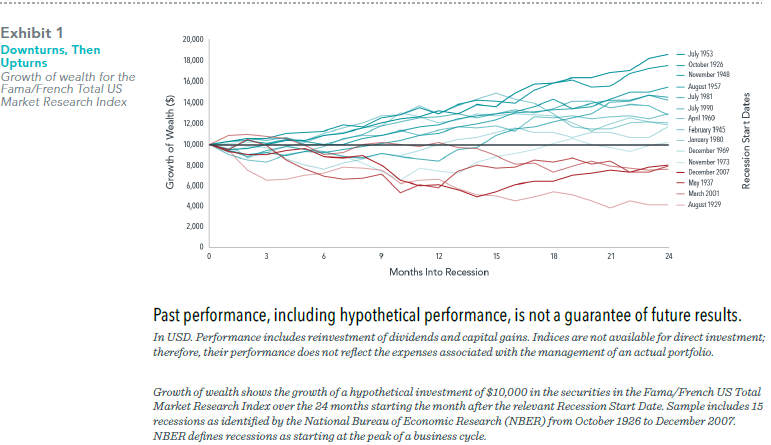
With activity in many industries sharply curtailed in an effort to reduce the chances of spreading the coronavirus, some economists say a recession is inevitable, if one hasn’t already begun.1 From a markets perspective, we have already experienced a drop in stocks, as prices have likely incorporated the growing chance of recession. Investors may be tempted to abandon equities and go to cash because of perceptions of recessions and their impact. But across the two years that follow a recession’s onset, equities have a history of positive performance.

Data covering the past century’s 15 US recessions show that investors tended to be rewarded for sticking with stocks. Exhibit 1 shows that in 11 of the 15 instances, or 73% of the time, returns on stocks were positive two years after a recession began. The annualized market return for the two years following a recession’s start averaged 7.8%.

Recessions understandably trigger worries over how markets might perform. But history can be a comfort for investors wondering whether now may be the time to move out of stocks.

GLOSSARY
Fama/French Total US Market Research Index: The value-weighed US market index is constructed every month, using all issues listed on the NYSE, AMEX, or Nasdaq with available outstanding shares and valid prices for that month and the month before. Exclusions: American Depositary Receipts. Sources: CRSP for value-weighted US market return. Rebalancing: Monthly. Dividends: Reinvested in the paying company until the portfolio is rebalanced.

_______________________________________________

Nelson D. Schwartz, “Coronavirus Recession Looms, Its Course ‘Unrecognizable,’” New YorkTimes, March 21, 2020; Peter Coy, “The U.S. May Already Be in a Recession,” Bloomberg Businessweek, March 6, 2020.

_______________________________________________

Sources: Dimensional Fund Advisors LP is an investment advisor registered with the Securities and Exchange Commission.

Kinds of Powers to Give to an Attorney in Fact

When you appoint another person to make decisions for you that are legally binding, you need to use a power of attorney to establish this authority. The person you empower is referred to as an attorney-in-fact. There are many different kinds of powers that can be given to this person, and the most common ways to use such a document include giving them authority for your medical decisions or your financial choices.

However, you can decide with your lawyer what makes the most sense in terms of giving powers to your attorney-in-fact. Tailoring the POA to work for you means thinking about whether or not you have other things you’d like to be able to pass on to this agent.

You can specifically name the kinds of things you’d like this agent to be able to do, such as:

  • Paying for a child’s medical expenses or college tuition
  • Hiring a repairman to fix something on your property
  • Handling government benefits or filing for taxes
  • Exchanging, purchasing, or selling certain goods
  • Giving to charities with your assets
  • Handling the management of your existing insurance policies
  • Accepting benefits and changing retirement plans

You can make your power of attorney document as specific or as broad as you choose. The important thing is that you have a lawyer review this document and walk you through the benefits or potential challenges of the way you’ve laid it out. This will give you clarity and the chance to update or adjust things as needed.

Not everyone can be an attorney-in-fact. This person must be classified in your state as an adult, should not be someone who is filing for or waiting approval for a bankruptcy discharge, and not the owner or employee of a nursing home where the principal (the person creating the document) is a current resident. It’s a good idea to select someone who is comfortable serving in this important role and someone who you trust with your affairs.

Have more questions about the process of creating and implementing a power of attorney? Speak with a lawyer today about your options.

Your Estate Plan Probably Needs a Trust

Some people assume that unless your estate size is substantial, that you can skip out on enhanced protections provided by something, such as a trust.

You might even assume that it’s not necessary to hire an attorney to create a will for you. However, a knowledgeable lawyer will take the big picture look at all of the issues in your estate plan including those you have not considered and provide you with a step by step roadmap that minimizes the potential of exposure to will contests and other lawsuits.

Your attorney can also help connect the dots between your situation and the strategies available to you, such as the benefits of creating a trust. Creating a trust enables a grantor or the person developing this trust to have more control over what their heirs do with money and assets and the manner in which the heirs receive this information. This can be especially important if you have younger heirs and you are concerned about their ability to effectively receive and manage these assets.

A trust can include specific rules designed at your discretion so that the heirs don’t, for example, receive all of the inheritance at once or they receive it after completing their college education, for example.

Additionally, by creating a trust you can also transfer property without exposing your assets to public record or going through probate court. If you don’t yet have a trust as a component of your estate plan, schedule a consultation with a lawyer today.       

How Long Would It Take for My Estate to Be Settled?

If you have done the necessary planning to ensure that your estate has been discussed with a knowledgeable estate planning lawyer, this is the first phase in protecting your desires and giving your loved ones an opportunity to receive the benefits you intended when you pass away. A common question either as a beneficiary to an estate or as you plan your own estate, is how long it can take for an estate to be settled.

Get help from a NJ probate lawyer

One year is a good rule of thumb for an estate to be settled. It can take a long time to dig through all of the details, to clean out the house or apartment, to file a final tax return, to liquidate any investments, pay off bills and even sell real estate. When everything has been held in trust and there is nothing in probate, it can go a lot faster. The process can also take longer if there are other complications, such as a need to sell real estate.

There can also be issues associated with anyone who files a challenge on the existing status of the will. Set up a consultation with our estate planning attorneys today to discuss how to make your estate easier to handle for your loved ones so that you have the peace of mind that comes with putting all of your estate plans in order.       

While it might seem like this process is a long ways off, you don’t want your loved ones dealing with the consequences of your lack of planning. Set up time to speak with an attorney who can help you structure your estate plan the right way.

Do You Have a Plan for Social Security Benefits with Your Estate?

Benefits provided by social security are often one component of an overall estate plan that can also easily slip through the cracks. It is essential to have a financial power of attorney to ensure that there is another person to step in and take care of your finances if you become unable to do so as a result of illness or injury.

A financial power of attorney is a crucial component of your estate plan and since part of managing your overall finances is to manage your social security benefits, it is important to realize that the social security administration doesn’t recognize power of attorneys. In fact, you may need to contact the social security administration in advance as part of your estate plan to name a designation of a representative payee.

This program was created under a 2018 law that allows a person to name one or more other individuals responsible for managing the applicant’s social security benefits. The SSA then must work with the named individuals or individual. You can rank up to three people as advanced designees and list them in order of priority.

A person who is already getting Social Security benefits at their age can also name an advanced designee at any time and someone who is just beginning to claim benefits from the Social Security Administration can also name the designee during the claiming process.

You can do this on the Social Security website or by contacting the social security administration over phone to get further support. Using the website is currently in your best interests as many different government agencies are being contacted by many people at once and there are long wait and hold times on the phone. Schedule a consultation with an experienced estate planning lawyer today to discuss benefits including Social Security that might affect your future planning.

These Two Cornerstones are the First Step Towards Making Your Estate Plan

Today, estate planning attorneys are being contacted at record numbers to get assistance in putting together power of attorney documents or wills in the midst of the pandemic. If you are in a situation in which you feel compelled to quickly pull together your estate plan, it’s important to partner with a knowledgeable professional in the form of an estate planning lawyer. Certain suggestions can help you accomplish your goals more effectively than others. 

One of the most important things you can do is to schedule a consultation with an experienced estate planning lawyer. An estate planning lawyer will have the necessary experience in understanding your state’s laws to be able to craft a legally valid document that takes into account the state and federal issues as well as your unique concerns when you approach your own estate plan.

There are many different questions that need to be answered and it is in your best interests to make sure that an attorney has helped you craft and review these documents to verify that they meet necessary rules and regulations.

Be wary of attempting to pull together a general estate plan or general estate plan documents, such as a will, on your own. While there are many online planning tools that can help give you the information to jumpstart this process, these should not be relied on as your only resource.

The second thing you can do to pull together your estate plan quickly is to create a valid will. It’s important that this document is created under the state laws of the area in which you reside. Some people believe that this can be a challenge with stay at home restrictions but you can contact your estate planning attorney to learn more about what you need to know and how you can jumpstart the process so that you do not miss out on the important opportunity to get your estate plan in line.

Scheduling a phone or Zoom consultation with your estate planning lawyer today is the necessary first step to give you peace of mind and to ensure that you are on track to create these documents that could become critically important now or in the future.

What Is Long Term Care Insurance? Do You Really Need It for Your Estate Plan?

Many older Americans have been thinking about the concept of long-term care insurance recently and with good reason. Chances are good that you’ll become injured or sick at some point during your retirement and require extra support to pay for your medical bills.

This is a service that can be especially valuable to long term care insurance policy holders. In the past, many of these policies were sold with one single premium, meaning a lump sum payment of up to $50,000 or $100,000 per individual. However, long term care insurance companies have evolved significantly to allow annual payments for this important protection. 

Since research shows that it’s approximately a 50% chance that a 65-year-old American will require some form of long-term care insurance in the future, you could be personally responsible for paying up to $140,000 if you don’t have this all-important long-term care insurance.

However, the vast majority of US seniors have put off purchasing long term care insurance because they think they don’t need it or that it’s too expensive. Only 7.2 million people in the United States currently have long term care insurance.

Those who choose to skip it are taking a big risk in doing so. Do you have a plan for what will happen to your money if you were to suddenly need LTC? Would it harm the savings plan you have in place with your spouse? Then you need Medicaid planning. 

It’s also important to remember that someone who faces challenges with long term care insurance might not only encounter these challenges in the concept of their retirement years. A person can sustain an injury that requires long term care rehabilitation at other ages in their life, such as a bicyclist who is struck in an accident and seriously hurt. Long term care insurance should form an important component of your personal estate planning responsibility.

Life Insurance: Is it Part of Your Estate Plan?

As part of an estate plan, your knowledgeable attorney might recommend different tools to help you accomplish your individual goals and allow for the streamlined transfer of assets to your loved ones. This can mean using something such as life insurance to help support other asset transfers within your overall estate plan.

There are three primary types of life insurance you might consider in this process: group, whole and term. Group insurance is most frequently offered as part of an employee benefits package and therefore, this is extremely convenient.

The challenge, however, is that this kind of insurance will not follow you during a career change and you’ll also want to determine whether the amount of the set policy is really enough to support your family in the event that you pass away.

Whole life insurance is much more expensive because it covers an individual for their entire lifetime while also offering an added benefit in the form of cash value that increases over time. It’s a good idea to have an advisor or insurance agent help you with this process since purchasing whole life can be expensive and confusing. The final kind of insurance that is most popular for people who are thinking about it in the context in their estate plan is term life insurance.

Term life insurance is the most affordable option and it is seen as renting insurance since you get the policy for a period of 10, 15, 20 or 30 years. This enables you to protect your income during your primary working years, for example.       

What Belongs Inside My Personal Will?

When there is no will for your estate plan, this puts your family members in a very difficult situation, because it becomes the responsibility of the New Jersey courts to decide what happens to your property. This is referred to as dying intestate and the settlement process that follows might not generate the results that you had intended for your survivors.

Essential Facets of Your Personal Will

There are four primary aspects that should be incorporated in your will. These include naming guardians for any minor children, instructions for when and how beneficiaries are entitled to receive assets, the names of beneficiaries who will inherit assets, and the designation of the person who will carry out the provisions of the will.

For assets that do not allow beneficiary naming, such as real estate or certain bank accounts, the will is an ideal place to determine who will get these and name any special instructions. Some assets allow for beneficiary naming and a direct transfer of the asset outside of the will. These usually avoid the probate process and include investment accounts, IRAs, and life insurance policies.

This can help to maximize what you leave behind to beneficiaries since these can typically avoid certain taxes and fees. Set up a time to speak with your estate planning lawyer today to learn more if you need more information about how to evaluate all the assets you own that belong inside your will.

Do You Really Need A Planner for an Estate?

Whether you are thinking about your investments and your retirement or how your estate plan answers many of your most common goals, you need assistance from an expert in the world of financial planning.

But finding the right person to assist you in addition to finding a knowledgeable estate planning attorney to help you think about how all these pieces connect can be complicated. You need to understand that there are new options available to you in terms of identifying financial professionals or estate planning professionals.

It’s a good idea at the outset of a relationship to understand how you might pay for this advice. Some planners even offer subscriptions with prices that are based on your income or your individual situation. This means that you can benefit from getting one on one access to the professional while not having to pay extensive fees. This gives you some form of regular access to the professional as well.

In addition to having an estate planning attorney to help guide you through many of the most common concerns that you might have as you near retirement age, it is a good idea to engage with other professionals who can assist you in developing a comprehensive plan.

For example, you might need the services of a CPA or a financial planner. Together these professionals can outline a plan that will protect you and your loved ones while keeping your personal goals top of mind.       

What Is a Healthcare Proxy?

NJ-healthcare-proxy

A healthcare proxy is a term you might have heard of in relation to comprehensive estate planning. The term proxy refers to another person acting on your behalf. With regard to healthcare proxies, this person is equipped to express your individual wishes on your behalf if you are unable to do so. Depending on where you live and where you execute this document, this might also be referred to as a durable medical power of attorney or your appointment of a healthcare agent. 

Of course, you know your personal healthcare wishes best, but if you were injured in an accident or otherwise unable to speak up for yourself, you need someone else to express your concerns.

Some people think that a healthcare proxy is only used if the patient in question is terminally ill. This is not the case. Your proxy is actually able to make decisions on your behalf any time that you are incapacitated and unable to communicate due to a temporary or permanent injury or illness.

There could be a natural fear that someone else is making decisions for you when you might be in a compromised state, but not enough of a serious medical condition to be totally unable to speak for yourself. A doctor might need to certify that you meet the grounds to be classified as incapacitated before your proxy is able to make decisions for you.

Remember that whoever you name in the role of proxy could potentially have access to your medical records depending on the permissions you allow. Make sure that the person you appoint knows about your personal religious beliefs, healthcare provider opinions and preferred institutions, medical treatment preferences, and personal feelings regarding illness and healthcare treatment.

Before you find yourself in a difficult situation with a loved one, make sure they’ve named someone as a healthcare proxy to speak for them. Assigning your own healthcare proxy is important, too!

Can New Jersey Residents Still Benefit from Irrevocable Life Insurance Trusts?

Irrevocable life insurance trusts have long been a popular estate planning tool in a variety of different circumstances to help achieve client goals efficiently and effectively. These were often used to shield life insurance proceeds from the estate tax in New Jersey by making the ILIT the beneficiary and owner of a life insurance policy, which therefore removed the proceeds from the individual’s overall estate.

In 2018, however, New Jersey repealed the New Jersey estate tax and now that the federal estate tax exemption is over $11 million per person today, many estate and trust attorneys have decreased their need and use with ILITs.

However, there are several different benefits to consider with these estate planning tools. Scheduling a consultation with an experienced and knowledgeable estate planning lawyer can be a first step towards recognizing how these can be helpful for your individual situation. An irrevocable life insurance trust gives you more control over your insurance policies and the money that is paid out from them. There are three primary components to an insurance trust.

The grantor is the person who creates the trust, the trustee is the person who manages it and the trust beneficiaries are the people who receive the assets after you pass away. An insurance trust means that the trust owns the policy and therefore, the trustee that you appoint in this role has to follow the instructions placed in your trust, giving you even more control over the proceeds. To learn more about how life insurance factors into the bigger conversation about your estate, schedule a consultation with an experienced New Jersey estate planning lawyer today.         

How to Minimize Mistakes During the Estate Planning Process

Since estate planning can be complex and should be aligned with your individual and family goals, mistakes can and do happen. All too often these common mistakes are ones that end up being revealed in the midst of a crisis or after the loss of a loved one.

The most common estate planning mistake is having no plan in place at all. Many people fall for the misconception that estate planning is only for those who are extremely wealthy, but estate planning can benefit people of all different estate sizes.

Estate planning, in fact, can be as simple as proper powers of attorney and asset titling and doesn’t need to include sophisticated trusts or other documents if that’s not relevant for you.

However, another common mistake with regard to estate planning is procrastinating when an agreement can’t be made between key parties. This is particularly relevant if a person has recently passed away and established a trust. If the terms of the trust were impacted by a mistake of facts, then the trust can be changed. If an understanding or mistake ever happens, it must be proven by clear and convincing evidence that must be held up in court.

To minimize the possibility of estate planning mistakes, it is in your best interest to schedule a consultation with a trusted estate planning lawyer who can help you craft these documents accurately from the outset or to review the existing documents and make recommendations.           

How to Remain Connected to Your New Jersey Estate Planning Law Office During the Pandemic?

Many law practices including ours have updated procedures, policies, and accessibility to be as helpful to you as ever in light of the need to meet virtually. Here at Shah & Associates, PC., our offices remain 100% staffed and virtual.

We are still here to help you with new estate planning documents as well as updating your estate plan and revising existing documents. We have remote file storage for all of our digital files to maintain top security and use zoom for online meetings.

Furthermore, our entire team has access to scanners, and we will continue to maintain digital portal access for everybody. Additionally, until we are able to meet our clients in person, we have also instituted remote signing procedures for temporary plans.

If you need assistance with temporary plans and want the peace of mind provided with continuing to develop your relationship with Shah & Associates, we are here for you.

We recognize that these are trying and uncertain times, but we are proud to uphold are commitment to doing right by our clients and putting your needs first. Schedule a consultation today over zoom or over the phone by contacting Shah & Associates. We are here to help and will help guide you and your family through these crises.           

Taking Your Time with Estate Planning

Sometimes it’s the loss of a loved one or someone in your family being diagnosed with Alzheimers’ that gives you the sign to put ‘estate planning” at the top of your to-do list. But the truth is that it can be dangerous to rush your planning if you’re doing it on your own. Hiring an estate planning attorney helps you by clarifying what’s really important and having another person to review all the details and give you pointers about what might have been left out.

To start with, an inventory of your assets forms the basis for your future estate planning. What do you have? What do you owe? Do these different kinds of assets mean different things for planning your estate?

A will, a power of attorney, and a medical directive are some of the most important documents you should create right away. There’s a good chance that you already know who- or what- needs to go inside those. But if you need additional support, this is a great opportunity to speak with your estate planning lawyer about what those look like.

Some aspects of your estate plan can be put into place immediately, like your will. Others, like an asset protection plan or a business succession plan, should only be developed with the support of a lawyer and with careful consideration and time. With those plans, the details matter and you should exercise every opportunity to implement the right time to talk through your options.

A lawyer’s review of both the simple and the complex estate planning documents can make a world of difference. Scheduling a virtual or phone meeting with your attorney makes it simple to accomplish this task from the comfort of your own home to get the ball rolling on these key documents and plans.

7 Steps for an Estate Plan Now

Do you have a plan for what will happen to your assets when you pass away? What about who will be able to make decisions on your behalf if you become unable to do so? These are just a few of the questions you’ll need to answer when you put together your estate plan and the support of the right estate planning lawyer can go a long way towards helping you.

For many people, estate planning feels overwhelming. Thankfully, there are a few stages to getting through this phase successfully that can make you feel more accomplished at the end.

Step 1: Look at Everything You Own and Record It

You can’t really know what your estate looks like until you inventory it. This makes the future planning steps much easier since you can decide what kind of strategies are best suited to your needs.

Step 2: Consult an Attorney

A lawyer can help you figure out what support you need in the form of documents and tools like trusts, and having your inventory already pulled together will make that process easier.

Step 3: Create a Will

Often the cornerstone of an estate plan, your will can name a guardian for a minor child and a basic distribution plan for assets.

Step 4: Check Beneficiary Forms

From your life insurance policy to your retirement accounts, there are some items that pass outside of will designations. Verify your forms filed with these companies are up to date.

Step 5: Evaluate Life Insurance Policies

Do you have enough coverage? A plan for protecting your family and loved ones while probate is pending? This is a good time to chat with your life agent.

Step 6: Form a Trust

You might benefit from one of the most powerful and popular estate planning tools in the form of a trust. Discuss which kind of estate planning trust is right for you.

Step 7: Consider Healthcare Options

Discuss considerations like qualifying for Medicaid and a healthcare power of attorney to ensure you have plans in place if you were to become ill and need additional support.

In your first estate planning meeting, your attorney can help you decide what aligns with your individual needs.

Yes, Even College Students Can Benefit from Estate Planning

People of all ages have the potential to recognize the possible benefits of estate planning but one that is often overlooked is when parents send their new 18-year olds off to college campuses in the fall without completing the appropriate estate planning steps.

A great time to think about estate planning is now as many students are nearing graduation and will be spending the summer getting ready for their new college experience. It can be difficult for parents to understand that legally children now have the ability to make decisions for themselves and that parents are not automatically opted in to health care and important medical decisions once the child has reached age 18. It’s a good opportunity to have an estate planning conversation with your teenager while he or she still lives at home.

These documents, like advanced directives, name people who are capable of making financial, medical, business and legal decisions in the event of incapacity. This means that people of all ages can use these tools to their benefit. If a child age 18 or older is injured in an accident or falls ill and is no longer able to communicate on their own or make decisions for themselves, the primary risk is a need for guardianship hearing to appoint another person. Usually as a parent, you would need to hire an attorney to file a petition with the court, asking for the judge to formally appoint the parent as the child’s legal guardian.

In emergency situations, the opportunity to do this can seem overwhelming and can add further delays unnecessarily. A power of attorney, however, enables a parent to make business, financial, and legal decisions on behalf of the child if and when that document needs to be exercised. Schedule a consultation with an estate planning attorney today to discuss this option.         

Estate Planning & Your Home Title

There have been many commercials and some news stories about people having their homes stolen. The narrative in these stories typically goes that a thief finds the title to your home by locating it online or hacking into it. According to this story, the thief then steals the title, forges documents, and end up owning your home, either having you evicted or mortgaging it.

This is a problem known as title theft, and multiple companies have recently emerged onto the landscape promising to help people by monitoring the title. In order for a thief to be able to accomplish this, they would need to find the title to your home online. In certain states, recorded documents like deeds are a matter of public record, and many counties have this information online.

A new deed could be forged when someone finds this information and then could be used to steal your home. However, a forged deed doesn’t necessarily convey the title to the home, but it could cloud the title on home making it problematic for you to pass it on to your loved ones in the future.

In most cases the state will require additional forms and filings to accompany a transfer of a title, and there’s plenty of information that must be submitted on these forms in order for it to be readily available for someone who is attempting to steal the title. Before passing on a piece of real property, it is important to understand how titling issues can impact transfer.

Schedule a consultation with an experienced estate planning attorney to discuss all of the different ways that you can protect your home and ensure a smooth transfer of it in the future.