Back To School Tips: Important Documents for Parents of New College Students

There’s no doubt that your mind is already pretty preoccupied with many different lists of supplies, last-minute shopping, and packing with your new college student. But it’s critical that you think about whether getting your adult child’s signature on two key estate planning documents is a good step. These two documents are a health care proxy and durable power of attorney.

So why, in the midst of everything else, should you be concerned with estate planning? In the majority of states, parent will not have the authority to determine health care decisions for children once those children have turned 18. This is true even if the parents are paying tuition or claiming those individuals as dependents on their tax returns. If the child were involved in an accident, for example, or became disabled, a parent might have to get court approval in order to act on behalf of his or her child.

Having both of the above-mentioned documents in place before your child goes off to college can give you a sense of peace and confidence that you will be able to act on behalf of your child in a worst-case scenario. Consider adding these crucial documents to your safebox at home today. In the event of an emergency, you can focus on caring for your child. Contact us today at 732-521-9455 or info@lawesq.net.

Back To School Tips: Important Documents for Parents of New College Students


Photo Credit: campaigner.com

Newlywed Estate Planning

While there is a great deal to celebrate getting ready for your wedding, don’t neglect this excellent opportunity to delve into your estate planning as well. Unfortunately, as you may already know, accidents can happen at any time. Of course we all hope that nothing impacts your new family and celebrations, but it is critical that you discuss your plans with your new spouse and outline your plans early. Remember that it will be much easier to update them later on once you have decided on the proper documents, but that you should never neglect putting your plan together entirely.

Newlywed Estate Planning

Photo Credit: gogirlfinance.com

You can begin with small steps, like changing your account beneficiaries. This is one of the easiest things to do in your overall estate plan, but there are big ramifications if you’re adding on your new spouse. Do it early. Make sure you update your life insurance, IRA, and 401k accounts, including any others that may have beneficiaries listed in the event that something happens to you.

Your next step should be to look over any wills that both of you have and to ensure that each individual has a solid will reflecting his or her current wishes. Powers of attorney and medical directives are also crucial for new spouses who may be updating their information from the past to reflect their new marriage. For more ideas about transitioning your estate planning to married life, contact us through email at info@lawesq.net or contact us via phone at 732-521-9455 to get started.

Do I Need a Trust?

As trusts have gotten more popular and evolved in type to appeal to a lot of people, so now you might be under the impression that you must have a trust. While it’s not for everyone, there are so many trusts out there that it’s very likely you could find one that will help you to meet your goals, including to protect your assets and minimize taxes.

Do I Need a Trust?

Photo Credit: epilawg.com

Major liquid assets, setting up care for a child with special needs, and a variety of real estate ownership are a few of the reasons that people might initially turn to trusts. If you’re a resident of a state with a high state estate tax, income tax or probate costs, you’re likely to be concerned about the hit of taxes, too. This refers to situations where a federal estate tax is factored into your asset value, but an additional taxable event occurs at the state level. Without proper planning, you could find that the value of the assets you have worked so hard to build is extremely vulnerable to these taxes and costs.

Contact our offices today to learn more about how these trusts can help you. Send us a message at info@lawesq.net or call us 732-521-9455.

Estate Planning Tips for the Blended Family

Second or third marriages can be very fulfilling, but they also bring their own set of challenges when it comes to estate planning. There could be children from previous relationships and children that have been born into the new marriage. If both parties were previously divorced, this can complicate property and other assets that have been brought into the marriage.

Estate Planning Tips for the Blended Family
(Photo Credit: revealedintime.blogspot.com)

You want to approach this issue by thinking about your individual estate planning goals first. Your assets, like investments, retirement plans, brokerage accounts, jewelry, cars, and houses, should all be considered. If you have not recently updated your beneficiary designations, you will want to consider whether your goals have changed as a result of a new marriage. Frequently people forget to update the beneficiaries on these important accounts after getting remarried, so it’s important to schedule an annual review with your estate planning specialist so that your documents always reflect your most current goals.

If there are certain items that you want your children to receive, make sure that you clearly note these items in your estate planning documents. Leaving all of the property to the surviving spouse may not be the best approach because it doesn’t ensure that those children will actually receive those benefits. In many cases, it’s most appropriate to use trusts to provide for the spouse while making separate plans for the children to receive the property. To learn more about our special planning for blended families, reach out to us through email at info@lawesq.net or contact us via phone at 732-521-9455.

For The Ladies: Special Estate Planning Considerations for Women

For the most part, financial planning and estate planning tools are very similar for men and for women, but there are several facts that result in special planning considerations for women as well. The root of these considerations is that in later years, women may face their own set of challenges.

For The Ladies Special Estate Planning Considerations for Women
(Photo Credit: businesshangouts.net)

To start with, women tend to live longer than men do. A woman may overlook the fact that odds are in her favor for outliving her spouse. In fact, according to the Census Bureau, nearly 40 percent of women over the age of 65 are widowed. That longevity may also lead to higher medical bills. When your financial future is built on a husband’s pension or Social Security benefits, the woman can face major challenges as a widow.

Women are also much more likely to provide care to children and elderly parents. Many women tend to take on this role for older parents, which can be emotionally challenging and a financial adjustments.

Women looking at estate planning should seriously consider where their income will come from in the future and what, if any, benefits they will be eligible for. If women are looking at caring for their own elderly parents, it’s also worth a look into the parent’s planning to see whether they have made plans for long-term care or factored in the financial aspects already.

A little advance work can go a long way in helping women live long and comfortable lives. To learn more about estate planning, email info@lawesq.net or contact us via phone at 732-521-9455 to get started.

What Can An Estate Planning Accomplish That I Can’t?

In this world driven by do-it-yourself options, it might seem like you can handle just about anything. There are several things, though, that you definitely want to hand off to a qualified estate planner rather than attempting on your own.

What Can An Estate Planning Accomplish That I Can’t?
(Photo Credit: design55online.co.uk)

To start with, even the most basic of estate planning documents, a will, probably needs customization. If you’re using some form of template, trying to invalidate it could turn out badly if you don’t do it appropriately. This could mean that your wishes are totally ignored due to an overlooked accident. Each state has specific provisions and wording, so make sure you’ve gotten yours reviewed by someone in the know.

If avoiding probate is one of the goals you have set out for your estate, you really should consider a conversation with an estate planner. The truth is that there are numerous ways to avoid probate and to minimize the blow of estate taxes, but those can be complex and require the eyes of a trained professional. Don’t count on yourself for those strategies.

One of the biggest reasons to trust your planner is because laws in the realm of estate planning have the potential to change often. You most likely don’t want to read through laws and regulations to understand your opportunities and responsibilities, but attorneys are up to speed on all the latest changes. What you can do on your own is to generate a list of what you’d like to accomplish with your plans and draw up questions you have about the process. Being proactive goes a long way towards proper estate planning. To set up a meeting, email info@lawesq.net or contact us via phone at 732-521-9455 to get started.

If It’s Good Enough for the Clintons, It’s Good Enough For You

The Clintons recently made the news simply for taking advantage of Estate Planning and financial planning strategies that maximize wealth and limit the encroachment of taxes. With an estate tax that has an upper limit of 40 percent of assets on death, it only makes sense for those with bigger estates to conduct some planning well in advance.

If Its Good Enough for the Clintons Its Good Enough For You
(Photo Credit: ihearttheclintons.tumblr.com)

One of the most important steps taken by the Clintons was the transfer of their New York house into a residence trust, a move they made back in 2011. These trusts have major advantages, including house value appreciation as an occurrence outside the taxable estate. The overall goal for many estate planning attorneys and other financial experts is to help build up the nontaxable estate as much as possible.

This transfer of ownership of the house specifically is a tool that could have implications for numerous Americans concerned about the tax hit on their estate. A sample strategy involving this plan is to divide house ownership in half and storing that ownership in two separate trusts. While continuing to live in the house, ensure that the trust is structured to pass on to heirs in 10 years. Remember, the growth value during that period falls outside your estate. At the end of the 10 year period, pay rent to the heirs if you plan to continue living in the house. Those rent payments are also shielded by passing outside of the estate, protecting them from tax.

For more tax-saving strategies and long-term financial planning, contact our office today. Call us at 732-521-9455 or send an email to info@lawesq.net

Avoiding Estate Planning Mistakes: Unfunded Living Trusts

When used properly, living trusts can be valuable tools for passing on assets. When planned for early on, you can really maximize what a beneficiary gets out of a living trust. Unfortunately, individuals don’t always plan correctly with the living trust. If you forget to put any assets into the trust, for example, you’ll miss out on the opportunity for assets to be passed to heirs outside of the probate process. After the trust is set up, you’ll need to retitle assets into the trust’s name.

Avoiding Estate Planning Mistakes Unfunded Living Trusts
(Photo Credit: kiplinger.com)

Simply listing the assets you plan to transfer with a schedule attached to the trust may not be enough. The schedule is more like a notification of the assets you do plan to transfer, but it doesn’t necessarily mean that you’ve actually transferred those assets. Real property is going to require a deed and bank and stock accounts will need to be retitled by financial institutions. You can speak with a professional estate planner to learn more about the steps to follow after establishing a living trust.

There are numerous trust possibilities that can help maximize asset value and minimize the influence of taxes, but you have to follow through on setting them up properly. To learn more about living trusts as an estate planning tool, email info@lawesq.net or reach out at 732-521-9455.

Is There a New Paradigm in Estate Planning?

Although more and more people are realizing the importance of estate planning, it’s possible to overlook the opportunities and to walk away with very basic documents that don’t address all of your concerns. An estate plan is most likely to succeed when the heirs who benefit have a positive impact from the plans, rather than being mired in arguments with one another. All too often, that’s what happens with family members, some of whom may spend months in court battling over the documents and decisions.

Although more and more people are realizing the importance of estate planning, it’s possible to overlook the opportunities and to walk away with very basic documents that don’t address all of your concerns.
(Photo Credit: bettersmartersaferway.com)

Planning for the future requires careful consideration that in many cases passes assets on to children with a plan for stewardship and responsibility. There are numerous cases where thinking well in advance is simply in everyone’s best interests, whether it’s to reduce the opportunity for conflict between children or to help make a business succession smooth. In a recent national survey, one of the leading reasons for individuals to evaluate their estate plans was to limit chaos among children.

In this way, you can think of estate planning as the best form of family leadership. It goes beyond tax saving strategies, trusts, and charitable giving (although those are all important). It is a process of planning that allows a family to empower heirs for a meaningful and a successful future. To learn more about estate planning for a variety of scenarios, email us at info@lawesq.net or contact us via phone at 732-521-9455.

Estate Planning For Your House: Irrevocable Trusts

A transfer of assets outright may not be the best solution as this has been known to create undesirable outcomes. In the case when planning to avoid probate and conservatorships, it makes more sense to use an irrevocable trust. In many cases, the biggest and/or most important asset to be transferred is a home.

Estate Planning For Your House Irrevocable Trusts
(Photo Credit: nwkidsmagazine.com/2012/01/1560/)

An outright transfer could cause problems: if it ever becomes necessary or desired to sell the property to buy a new one elsewhere, this can be difficult. Also the new owners might lose the residence to creditors or divorce or sell it on their own. That’s why it may be preferable to use an irrevocable trust to ensure protections and flexibility in planning. This can be done using lifetime retaining benefits held by the transferor.

There are benefits to using an irrevocable trust to manage the house transfer. First, the residence is protected from the threats of creditors or ex-spouses of death beneficiaries or the trustee. Second, if there is interest or need to sell the home to acquire a new one, the trustee can navigate this move fairly easily, If drafted properly. To talk more about how to plan for the transfer of your home, we can help. Email us at info@lawesq.net or contact us via phone at 732-521-9455.

Married Couples without Children: Estate Planning Recommendations

Your individual estate plan is going to depend largely on your personal situation and the goals you have for your assets. That being said, one major factor that can alter your estate planning situation tremendously is children. Without children, some couples might wonder what estate planning options could be used.

Married Couples without Children Estate Planning Recommendations
(Photo Credit: lancewoodley.com)

One such example is a QTIP trust, or a Qualified Terminable Interest Property Trust. This trust gives a benefit to the surviving spouse that keeps the assets out of the hands of creditors. Using this trust properly, assets from the trust that are still present after the surviving spouse passes away would then be given to beneficiaries stipulated by the spouse who passed away first.

A big benefit to this approach is that the personal representative of the first spouse (referring to the spouse who passes away first) can exert some flexibility over the best way to proceed. A partial QTIP election or portability election are the choices that a personal representative might consider after the first spouse passes away. One factor to bear in mind is ensuring that the applicable exclusion amount of the first spouse doesn’t go to waste, which can be addressed in planning strategies with your estate planning specialist.

Your family structure and how involved your family is in your own estate plans strongly dictates what needs you have when you come to the table to discuss your goals and concerns. To learn more, email us at info@lawesq.net or contact us via phone at 732-521-9455.

Changing Your Power of Attorney

What if you already executed a power of attorney some years ago and now want to change that person? Is it as simple as revoking the old one and creating a new one? Make sure you’ve investigated whether your power of attorney is “durable” or “springing”. What’s the difference?

Changing Your Power of Attorney
(Photo Credit: monkeyoffyourback.com)

A springing POA is a person who has not yet assumed his or her position yet, making it much easier to change your plans. If you named someone else as a backup and would prefer that person now be your POA instead, you can amend your existing power of attorney to reflect this change in plans.

If the POA is actually a durable attorney, meaning that this individual was empowered to act on your behalf immediately after the document was executed, you may need to do a little more work. You should use certified and first class mail to notify the original individual that he or she has been removed as POA in case there is a dispute down the line about termination and institution of a new POA. If you believe that this person is out there exercising authority under your old Power of Attorney, you’ll need to take responsibility for contacting banks or other institutions where this is an issue. Make sure you have your estate planning attorney keep copies of all your documents on file in case there are any questions. To begin or change a power of attorney and any other estate planning documents, call us at 732-521-9455 today or request a meeting via email at info@lawesq.net.

Side Business? Silent Partner? What’s the Risk? Duties of non-manager members of LLCs

If you are interested in creating a managed multi-member LLC, one of the most popular questions for individuals in this position is whether non-manager members are held to the same standards (or have the same liability) with regards to fiduciary duties like care and loyalty. The answer is “it depends”.

Side Business Silent Partner Whats the Risk Duties of nonmanager members of LLCs
(Photo Credit: serpent.com)

In the non-manager members are involved in some significant aspect of the business, the operating agreement should generally include an expression of such duties for these individuals. Looking at the landscape of typical non-manager member involvement in the business of these LLCs, significant duties are typically rare with smaller businesses that are closely held.

There are some cases where the operating agreement might not address this question specifically. In this scenario, the LLC act governs and can provide some important insight. A lot of these acts, however, are quiet when it comes to this particular question. Some agreements, however, do have specific information about these duties included. An example is the Delaware Limited Liability Company Act, which actually negatives any duties for the non-manager members unless an express clause in the LLC agreement states anything to the contrary.

LLC formation and agreement construction can be aided significantly with the watchful eye of an attorney. Call us at 732-521-9455 or send us an email to info@lawesq.net to discuss your needs.

Do You Have a Digital Fortune?

The estate planning landscape is changing, and it’s because our approach to determining assets is changing, too. According to a survey by McAfee, Americans believe they own an average of about $54,000 in digital assets. Curious about a digital asset? What about your big ITunes collection? Downloaded resources and books on your Kindle? What about Paypal? Bitcoins? Or even more sentimental accounts, like a genealogy archive that’s helped you to identify relatives?

Do You Have a Digital Fortune
(Photo Credit: mariopartylegacy.com)

Getting access to these materials can be difficult after a family member passes away. Your email account materials might be deleted before family members can even access the material and in the meantime, your accounts could be exposed to online theft risk.

This is where a Digital Estate Plan steps in. It will help your will executor carry out your wishes in the distribution of your assets. This can be a complex process, since many of the sites mentioned about base their service agreements on federal laws. Nevertheless, it’s an important exercise to gather up an inventory of material you might like your family to be able to access if something happens to you. At the least, your family will be aware of the information’s existence. Login information and passwords should also be included with this material.

Make sure you’re up to date with estate planning laws and trends by working with an experienced attorney. Reach out to us to get started at info@lawesq.net or contact us via phone at 732-521-9455.

For Student Loans – Read the Fine Print: Risks for Student Loan Borrowers and Co-Signers

The details matter when it comes to getting a signature on your student loan agreement: it turns out that some private student loans have a caveat for what happens if the co-signer passes away. In some private loans, the student or recent graduate has to pay up if their relative passes away- immediately and in full. If the borrower can’t make that payment, he or she faces a big hit on their credit rating.

For Student Loans Read the Fine Print Risks for Student Loan Borrowers and Co-Signers
(Photo Credit: dailyfinance.com)

Many students who have to use private loans to finance their education might not even notice the provision, but it’s legal. Receiving a notice for demanded payment in full often terrifies a recent graduate, who may ignore the notice and suddenly feel buried financially. Borrowers can have their loans released after a few years of earnings and positive credit history, but they also have an option to transfer to another co-signer. Unfortunately, not many students are aware of these options right away.

When it comes to student loans, it’s important to read all of the stipulations in the loan agreement, especially when it’s a private lender. Make sure you walk through all of your options if a parent does pass away, too. No one plans for the situation where a parent or relative passes away in this manner, but it’s worth factoring into your general estate plan if you are a co-signer on someone else’s loan. Ensure that the borrower knows and has a plan for how they would handle such a situation. To learn more about a comprehensive estate plan, contact us through email at info@lawesq.net or contact us via phone at 732-521-9455 to get started.

For the Furry Ones in Your Life: Estate Planning With Pets in Mind

Although many people have heard about the traditional aspects of estate planning, like a will, it’s all too often forgotten that you may have others you need to include in your plans. The majority of houses across the country have pets inside, and it’s worth considering what you’d like to happen to your animals if something happens to you. Pets are treated as personal property, so it’s crucial that you do a little research about where you’d like them to go.

For the Furry Ones in Your Life Estate Planning With Pets in Mind
(Photo Credit: the-hunting-dog.com)

A pet trust, for example, can outline the type of care your animals will receive after you pass away. With a funded pet trust, you can rest assured that your animals will be taken care of no matter what. This trend is expanding in use across the estate planning industry. A first step in your pet plan is to write a description of all animals, including any distinguishing characteristics. This helps to avoid copycat pets or mistakes receiving care that you intended for your own animals. Microchip numbers, too, should be included for identity verification.

You can work with an estate planning professional to determine the cost of care for your animal. Factor in vet care, routine medications, any special supplements, pet insurance, and food, multiplied by the life expectancy of your pet. Talking this over with any family members can be helpful for establishing those who may want to care for your animals, too. Have questions about pet trusts or other planning tools? Send us an email at info@lawesq.net or contact us via phone at 732-521-9455.

Estate Planning and Reproductive Technology

Unfortunately, estate planning law hasn’t really stayed on pace with reproductive technology and rights, generating quandaries about inheritance rights. It would make sense that children conceived after the death of an individual (or statements denying inheritance rights about these individuals) should be included in estate planning documents.

forbes.com
(Photo credit: forbes.com)

A trust might be a more appropriate vehicle for managing inheritance rights in this way when compared with a will. A comprehensive estate plan, too, can also be valuable with regard to genetic material. Much the law with regard to inheritance rights and genetic material is very specific to each state, which is why it’s recommended to work with a professional if you’re concerned about children conceived posthumously. In many states, the law has not provided a framework for the disposition of embryos or gametes at the death of the donor.

While not every estate plan will include such instructions and details, it’s critical that those in this situation think about whether those individuals conceived later will have any inheritance rights. Planning in advance for this and documenting your wishes is a vital step in ensuring that your wishes are carried out after you have passed away. Advance planning can be complex, but the process is made easier when working with an experienced estate planning lawyer. To learn more about complex estate planning needs involving reproductive issues, contact us at 732-521-9455 or email us at info@lawesq.net

How to Bulletproof Your Estate Plan

Challenges to wills and trusts are more common than you might think.

These disputes can turn very ugly, very quickly. Resentment between family members can last a lifetime, and the financial consequences can be devastating for all parties involved. Here are several ways to prevent potential disputes from arising in the first place, avoid estate litigation, and help ensure your wishes are carried out.

Bullet-proof-Glass
(Photo Credit: wpcsd.k12.ny.us)

Try to treat siblings as equally as possible
Granted, in some family situations this may seem easier said than done. However, the principle is sound and can help avoid a number of potential problems. If you have two children, leave each of them the same amount. However, the “equality principle” doesn’t just apply to money. There is also the issue of control. If one of your children seems better able to manage money and you name him or her as executor of the estate (or trustee of the trust), the other child will likely feel slighted. Naming a corporate executor or trustee can nip this thorny issue in the bud. Another potential problem is when inheritances are left to grandchildren, and one sibling has more grandchildren than the other. However,

if you follow the equality principle, many conflicts can be avoided.

Never underestimate the emotional value of certain family heirlooms and other tangible property
That vase in the foyer or old sofa in the living room might not seem valuable to you, but to certain members of your family it could hold special meaning and value. A statement in a will or trust that essentially says ‘tangible personal property should be divided as my heirs see fit’ can lead to a host of conflicts. By putting specific items that you believe are of interest to certain family members in writing, and discussing these decisions in advance, many emotionally charged disputes can be avoided.

If you gave money to one heir in the past, don’t forget about it your plan
Let’s say that several years ago you gave one of your sons $20,000 to help with the down payment on a home. Since your goal is to treat all of your children equally, you might want to address this gift in your will or trust. For example, it can be classified as an advancement, with the $20,000 counting as part of the money you ultimately leave to that particular son.

Consider putting a no contest clause in your will
If you suspect that one of your children, or his or her spouse, might make trouble over your will, a no contest clause can help avoid potential problems. In essence, this clause makes the risk of challenging your will outweigh the potential benefit of doing so.

A no contest clause typically stipulates that if a beneficiary contests the will’s validity its provisions, his or interest in the will is forfeited. Of course, you have to leave the heir in question enough of an inheritance to motivate him or her not to challenge the will.

Prove that you are of sound mind
This might sound “crazy,” but it’s not. Challenges to wills often involve allegations that the maker of the will (the testator) was not of sound mind when the will was signed. This tactic is particularly common when changes have been made to the will shortly before the testator’s death. You can help prevent this type of challenge by obtaining an evaluation from a treating physician and a psychiatrist right before you sign or make changes to your will.

If you are going to disinherit someone, make sure it is noted clearly in your will
Our children can and sometimes do disappoint us. Sadly, the level of disappointment may be so severe, the behavior so egregious, that the only solution seems to be disinheriting the son, daughter, or grandchild entirely. If you find yourself in this situation, make sure your decision is noted in your will. You don’t want to give a reason for your decision, as this could become the foundation for a potential lawsuit. However, you need to make it clear that your decision was intentional.


Discuss Finances Before Saying ‘I Do’

If you or someone you know is planning a wedding anytime soon, there are many things to consider. One of the most important of which is finances. You must discuss money with your future spouse, even if doesn’t sound romantic.

English: A Catholic wedding ceremony in Milwau...
(Photo credit: Wikipedia)

Talking about finances is at least as important as discussing the reception or honeymoon. Maybe more important.

Talking about finances — budgets, insurance, savings and so forth — could be critical to ensuring a happy marriage, says a story on cnbc.com.

Setting a specific time to sit down and talk about how you want to organize your finances after marriage is key. Will you have joint checking accounts or separate ones? Who is going to manage the money and pay the bills? These are just some of the questions that must be asked.

It is also critical to set a budget and put your expenses and financial goals down on paper. It is important that each partner be okay with the other’s spending habits.

If there are disagreements, the couple may want to obtain the advice of a marriage counselor or financial advisor.

Other areas to discuss are life insurance ( a “must” for most couples, according to the article); debt, if there is any;  disability insurance; homeowners insurance; health insurance; and an estate plan, or at least a plan to designate beneficiaries in case of one’s death.

Enhanced by Zemanta

3 Estate Planning Mistakes From Which To Learn

If you haven’t already done your estate plan, perhaps hearing a few horror stories about people who made common mistakes will prompt you to do it — and do it right.

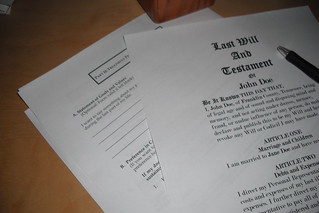
Last Will And Testament
Last Will And Testament (Photo credit: Ken_Mayer)

An article in the Green Bay Press Gazette, recounts a few cases that detail classic mistakes involving estate planning, or the lack of it.

  • A former Supreme Court justice wrote his own will, using just 176 words. It cost his family $450,000 in estate taxes and court fees because he didn’t take the time to do it right.
  • Lesson: Know what you know, know what you don’t know.

  • A young woman left her assets to her minor son. When she died, she had $1 million in her estate due to a wrongful death claim. Her son died soon afterwards and the money went to his only heir, his father, who was a drug addict.
  • Lesson: She could have put the assets into trust with a contingency plan were he to die, so the money could not go to the father.

  • A father had a stroke and had to go into a nursing home. His children closed his bank account but never went through his mail. After he died, they found a statement for a $1 million life insurance policy. But the premiums had not been paid since the bank account was closed. They didn’t get the money.
  • Lesson: Make sure somebody knows what assets you have, usually the person who has power of attorney, a trustee named in a trust you have set up or the personal representative named in your will.

These are common mistakes that can be avoided if you engage a qualified estate planning attorney to help you with your estate plan.

Enhanced by Zemanta